Oni Ukiyo-e: Japanese Demon Folklore & Warrior Prints
Oni Ukiyo-e Explained: The Demon Folklore Behind Japanese Warrior Prints
Horned, grinning, wild-eyed - the oni is the face that stops you in a Japanese print. It shows up behind a warrior, under a storm cloud, or coiled into a tattoo-style sleeve, and it never looks quite friendly.
But who - or what - is an oni, and why does it keep turning up in ukiyo-e woodblock art? Here is the beginner's guide: the folklore behind the demon, why artists printed it, and how a modern oni or warrior print earns its place on a Japandi wall.
What Are Oni in Japanese Folklore?
In Japanese folklore, an oni (鬼) is a demon or ogre - a powerful supernatural being that is more force of nature than personality. Think of it as the collision of a mountain spirit, a plague, and a thunderstorm, all wearing a humanoid shape.
The classic oni look is unmistakable:
- Horns and tusks - usually two horns and a jaw full of sharp teeth.
- Wild hair and fangs - never tidy, always feral.
- Bold skin colors - red, blue, and black are the most common.
- A club or kanabo - the huge iron weapon it swings like a twig.
- A tiger-skin loincloth - the traditional oni uniform in art.
Oni are not simply evil. In Buddhist and folk tradition they punish wrongdoing and guard the gates of hell - but they can also be cruel, greedy, and stupid enough to be outwitted. That mix is exactly what makes them fascinating. They are the untamed, the chaotic, the part of the world that does not obey.
Why Oni Appear in Ukiyo-e and Warrior Prints
Ukiyo-e - "pictures of the floating world" - was the popular woodblock art of Edo-period Japan, and it was built on drama. Artists printed actors, courtesans, landscapes, and above all stories. Oni were perfect story material.
They arrived in prints for a few reasons:
- Folklore was the blockbuster entertainment of the day. Legends of heroes battling demons sold prints the way blockbusters sell tickets now.
- Oni made conflict visible. A warrior print needs a threat. An oni gives the hero something fearsome to strike down.
- They carried moral weight. Many prints show oni being punished, tamed, or converted - a visual lesson wrapped in spectacle.
- They were graphic gold. Bold forms, high contrast, and pure color made oni ideal for the woodblock medium.
This is why the oni and the warrior live in the same print. The demon is the obstacle. The warrior is the will that meets it. Put them together and you get a picture about courage, resistance, and the human refusal to back down.
From Woodblock to Wall: Demon and Warrior Motifs Today
You no longer need a museum to live with these motifs. Modern Japanese-inspired wall art borrows the oni's power and rebuilds it for contemporary interiors.
The best modern pieces keep what made the originals work - bold line, deep color, unapologetic contrast - and strip away the clutter. A fierce female samurai wrapped in a flowing red cloak. A kabuki figure in a crane kimono. A tiger, a panther, and a skull locked in a tattoo-style composition. These are not reproductions. They are the folklore, reimagined for a wall that has to feel alive.
That is the appeal of a limited-edition statement print: it carries the same mythic weight as the woodblock originals, but it belongs to your space - and once the run sells out, it is gone.
How to Style an Oni or Warrior Print in a Minimalist, Japandi Interior
Japandi interiors - the meeting of Japanese restraint and Scandinavian calm - thrive on quiet, neutral rooms with a few confident objects. A demon or warrior print is that confident object. Here is how to make it land.
1. Let one piece hold the wall. Japandi is about restraint. Choose a single oni or warrior print and give it generous space. One dramatic piece beats five busy ones.
2. Keep the palette tight. If the artwork runs red, blue, and black, keep the surrounding room in warm neutrals - off-white, oak, charcoal, taupe. Let the print be the only loud voice.
3. Frame it simply. A slim black frame on natural wood, or an oak frame with plenty of white mat, keeps the focus on the art. Avoid ornate frames - the print is the ornament.
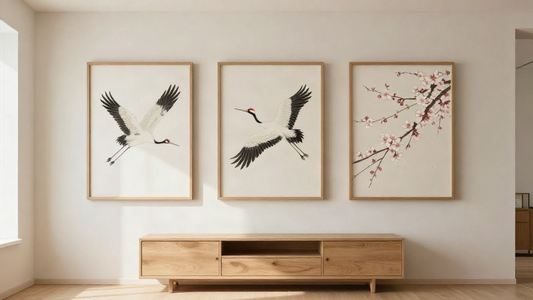
4. Match the mood, not the room. An oni's intensity suits a study, a hallway, or a living room that needs a focal point. Softer motifs - a crane, a blossom, a minimal ink cat - sit happily even in a bedroom.
5. Ground it with texture. Pair the print with a linen sofa, a paper lantern, a ceramic vase. Natural texture softens a fierce image and keeps the room feeling calm rather than aggressive.
6. Hang at eye level. Center the artwork's middle around 57-60 inches from the floor. It is a small rule that makes a big difference.
Why Oni Still Speak to Modern Rooms
The oni has survived centuries because it says something true: the world is wild, and courage is a choice. Hanging one on your wall is not decoration for its own sake. It is a statement - a reminder that boldness belongs in your space.
The folklore started in woodblock prints. It does not have to end there.
Explore the Japanese-inspired collection at Beyond Reality Artworks - fierce warrior prints, tattoo-style demons, and minimal ink pieces, each released as a limited edition that will never be reproduced. When it is sold, it is gone.
Frequently Asked Questions
What does oni mean in ukiyo-e? In ukiyo-e, an oni is a demon or ogre from Japanese folklore - a horned, fanged, often red or blue figure that symbolizes chaos, punishment, or a threat for a hero to overcome.
Are oni evil? Not purely. They punish wrongdoing and protect sacred spaces, but they can also be cruel or greedy. Their moral ambiguity is part of why artists loved them.
Why are oni paired with warriors in prints? The oni supplies the danger and the warrior supplies the courage. Together they turn a picture into a story about resistance and strength.
Can a bold oni or warrior print work in a minimalist home? Yes. Japandi interiors rely on calm backdrops, so one strong demon or warrior print becomes a deliberate focal point rather than noise. Keep the room neutral and let the artwork lead.
Tags: